Showing posts with label Permaculture Systems. Show all posts

Monday, June 18, 2018

High Productivity in Dry Conditions - Part 2


High Productivity in Dry Conditions - Part 2

In part 1 of this blog post series, I talked about a design for growing water hungry plants in dry conditions.


In this post, I thought I would share my experience installing some of these in my own garden to see how they go.

My garden beds are 48'' wide double-reach beds, so a 48'' diameter circle bed was the natural choice for this project.

I chose an area that has not been touched this season, and was overgrown with horsetail, chickweed, lambs quarters, and grass.

I started by digging a hole in the middle of the garden bed, and building up a doughnut shape of soil. I pulled the biggest plants out and left the rest in there as you can see from the photo to the right.

It was a rough as guts installation, and took less than 5 minutes. I then scrunched up the plants I pulled previously, and stuffed them into the bottom of the hole.


I patted the soil and shaped it a bit to make sure I had a solid ring into which I will plant the seedlings later.


After that, I took some garden debris from last year and filled the hole with it.

The next step was to cover the entire thing in newspaper. Each placement you see in the photo is approximately 6 sheets of newspaper thick, and I started at the base and worked my way into the center, making sure there was a good overlap.

This will act to keep moisture in the soil, and prevent any unwanted plants taking over.


I also made sure there was a ready pathway for water to enter through in the center of the circle.


I watered the paper down to make it all stick together, and topped it off with some semi-finished compost.


Finally, I covered the entire thing with a thick blanket of old straw and gave it a good watering.
I made two more of these. One that used hay instead of straw to see if it really makes that much of a difference.
And the final one is positioned under a tree where it receives lots of sun but very little water. 

In fact, it is so dry, and the soil so sandy, that I couldn't really form a decent doughnut shape because the soil wouldn't stay in place.
This spot barely grows anything except the odd dandelion and some grass. It's a very difficult corner of the garden and so it will be a great test location for the circle garden.

Thursday, June 14, 2018

High Productivity in Dry Conditions


High Productivity in Dry Conditions

The spring of 2018 has turned out to be unusually dry, and it's now pretty safe to say that the spring rains never came.

It was also an unusually cold start to spring which delayed everything by a few weeks.

The long term climate forecast models used for things like commodities markets, launching rockets into space, and other critical sectors of human activity are pointing to a continuation of the global cooling trend that has been in place for the past decade or so.

The geopolitical implications of this, should it come to fruition, isn't the topic for today. Rather, I thought it would be good to write about some techniques that can be employed in the garden if this exceptional dryness becomes the norm.

Hopefully by now everyone should be aware of the benefits of mulching and how it reduces the need for watering by a factor of 10. Direct seeding in a mulched garden bed can be a challenge which means that more often than not a mulched garden bed also means seedling transplants.

But let's focus on mulching systems as a means to conserve water and hold nutrients within the system longer.

The image to the right is a banana circle. It is a mulching system used in the tropics for the production of bananas, and it has been reported to produce 100 times more bananas per square meter than the traditional plantation method.

Pretty much every permaculturist knows what one of these are and how it's constructed so I'm not going into the details here.

But what if we can adapt the principles of a banana circle and apply them to the great white North?

The system is constructed by building a doughnut shape with your soil into which you will plant your crops. The middle of the doughnut is then filled with coarse unfinished compost / mulch and then the whole thing is covered in a thick layer of straw or hay.
Converting a 15 foot long double reach bed will yield roughly 50 square feet of growing space as illustrated above. I employ double reach beds in my garden, and find that 3 rows in the bed are manageable. 

This method delivers the same amount of growing space as I usually have, and there is the added bonus that I'm utilizing the center areas to finish off my compost from the year before. I have essentially stacked two functions into a space that I'm currently using to perform just one.

When you go to water the bed, you simply pour the water into the center area and let it wick into the growing bed from the center. No drip irrigation or sprinklers required. Just dump the water in there!

This system is suitable for water hungry plants like squash, melons, tomatoes, peas, beans etc.

Read Part 2 to follow my implementation of this concept.

Friday, July 18, 2014

Northern Communities Food Security

Northern Communities Food Security

I saw in the media a few months back that the northern communities and the government had been meeting to discuss food security and all the aspects this involves.

There are many different facets as one can imagine. Social, cultural, logistical, climate, and economics.

Unlike almost any other scientific endeavour, permaculture is non reductionist. It was interesting to note that the investigative panel consisted of a number of academics who specialise in a particular field, but there were no system thinking people who understand the behaviour of highly interconnected systems.

Anyway, this is not the reason why I decided to write about this. I decided to write about this because it makes sense that in remote communities, food security requires:
  • Being close to the food source.
  • Having robust food production systems.
  • Being as self sufficient as possible in terms of energy, water, and food.
  • Having self sustainable systems for food production and processing.
It seems obvious to me that these are all aspects that are central to most, if not all permaculture designs, so let's pretend for a moment that the expert panel had some permaculturists...

Assume for this exercise that the people of Northern communities desire self sufficiency and place a value on dietary nutrition. Assume too that the commercial interests of those supplying these communities under the status quo are eliminated. How does one go about designing practical food production systems for this climate?

The northern communities are located in boreal forest, and tundra where it's too cold for trees to grow in abundance. We're talking USDA hardiness zone 1 and 2 which doesn't leave a lot of perennial edibles capable of surviving such extremely low temperatures.

In a situation like this it makes sense to look closely at micro-climates and the use of earth works to facilitate a more hospitable climate. When it comes to cold climate micro-climates, the worlds most experienced permaculture expert would be Sepp Holzer.
Lets take a look at what he's been up to recently and see if it might work in the far North...

Sepp has been busy developing what he calls "Crater Gardens" in Siberia. If there is a climate analogue to the Northern territories then Siberia makes sense. We can confirm this by consulting the Köppen Climate Classification System.


We can also confirm it by using the on line climate analogue tool, which identifies Russia, and the Scandinavian countries as being similar.

So what is a crater garden? 
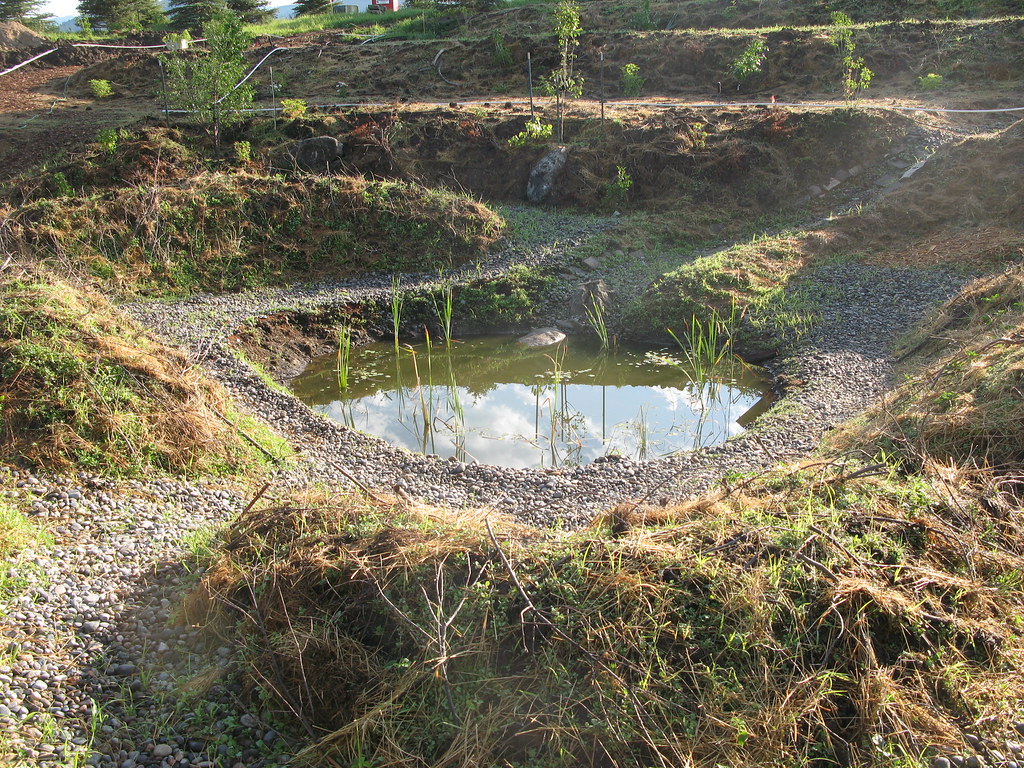
A crater garden (kratergarten) is an artificially created micro-climate growing system built into the ground and resembles a crater.

Earthen berms are constructed around the perimeter to act as wind breaks and trap heat.

The inner walls of the crater are terraced so that there are flat areas that can be used to grow crops and provide easy access.

An option is to construct the terraces in a spiral formation so that access to the bottom of the crater is gradual, minimising erosion effects of water.

At the bottom of the crater, a pond is constructed. This performs a number of functions:

  • Reflects solar energy up onto the terraces.
  • Increases humidity within the crater.
  • Acts as a thermal mass that releases heat during cold nights.
  • Provides an environment for beneficial insects and other animals.
  • Provides a growing environment for fish and aquatic plants.
  • Acts as an accumulation and collection point for nutrients.

Here is a short video of people constructing a crater garden:


The resulting micro-climate can be 3 hardiness zones warmer, and the growing season extended. This effectively means that anything that grows in Thunder Bay would grow in a crater garden situated in Fort Severn.

Here is another series of videos that record the installation of a large crater garden in a Northern climate:


Now that a suitable micro-climate has been established using berms, terraces, ponds, and rocks, growing beds can be constructed. One very practical option is to use Hugelkultur. 


The great thing about hugel beds are that they last about 20 years and require no fertiliser or irrigation. This means the logistics of transporting these materials is eliminated, as is winterizing irrigation lines.


In regions where trees are not available, alternative material like grasses / hay / brush can be used in their place.

Now a crater garden takes a lot of effort, or heavy machinery to establish. However, it will be there for 1000 years or more which means that the energy required to establish and maintain it is greatly exceed by it's outputs over the lifetime of the system. This is truly sustainable. 

What can be grown in these Northern communities? Well as I've already pointed out, anything that can be grown in Thunder Bay should grow using crater gardens. Apples, pears, plums, berries, and annuals.

In later posts, I'll investigate some interesting food plants that have commercial potential for the Thunder Bay region. I also have a very interesting commercial tree crop in mind that will grown not only in Thunder Bay but the Northern communities as well. Stay tuned.