Showing posts with label Business. Show all posts

Friday, March 9, 2018

Lean Ag Start-Ups

Lean Ag Start-Ups

Is it possible to apply the business models that tech industry embraces in the Silicon Valley start-up community?

What are these models anyway?


Basically, lean start-ups apply a circular process to their venture. 

The process starts with ideas, followed by the act of building results in the form of a product (or service), the performance of which is measured, and the data used to learn various facets about how successful the product is in the market.

The business owner hopefully comes away with some new ideas for improvement, which are then applied and the cycle repeats.

Lean start-ups are also characterized by a "fail fast" ethos, which translated into more meaningful English, means to commit as little energy as possible to investigate the viability of a venture in such a way that it's success or failure can be quickly determined.

But agriculture businesses are typically capital intensive activities. The land is expensive, as is much of the machinery needed to effectively farm the large acreage needed to extract profitability from low margin / high volume commodity products. 

I have previously talked about the option of leasing land, which is a way to drastically reduce capitalization costs and subsequent debt loads.

But I have not yet discussed the issue of machinery and infrastructure costs and how they can be largely mitigated.

If a square meter of land can be utilized in such a way that the productivity is doubled, or even tripled, then the space required to generate a viable agricultural business reduces accordingly. With less land required, less machinery and infrastructure is also necessary.

So how small can you really shrink an operation and yet remain economically viable? You might be surprised to discover that it's smaller then you think...

Curtis Stone started Green City Acres in Kelowna with only $8,000 and turned a profit of $20,000 in his first year.

His business is now generating $100,000 per acre of land due to his lean approach to market gardening.

Curtis uses a system called SPIN (Small Plot INtensive) and applies it to an urban setting where people let him convert their backyards to productive vegetable gardens in return for some of his produce.

He doesn't own the land, and the land comes with infrastructure such as water supply and electricity.

You can follow Curtis on Youtube where he publishes tips, updates, and how-to videos.
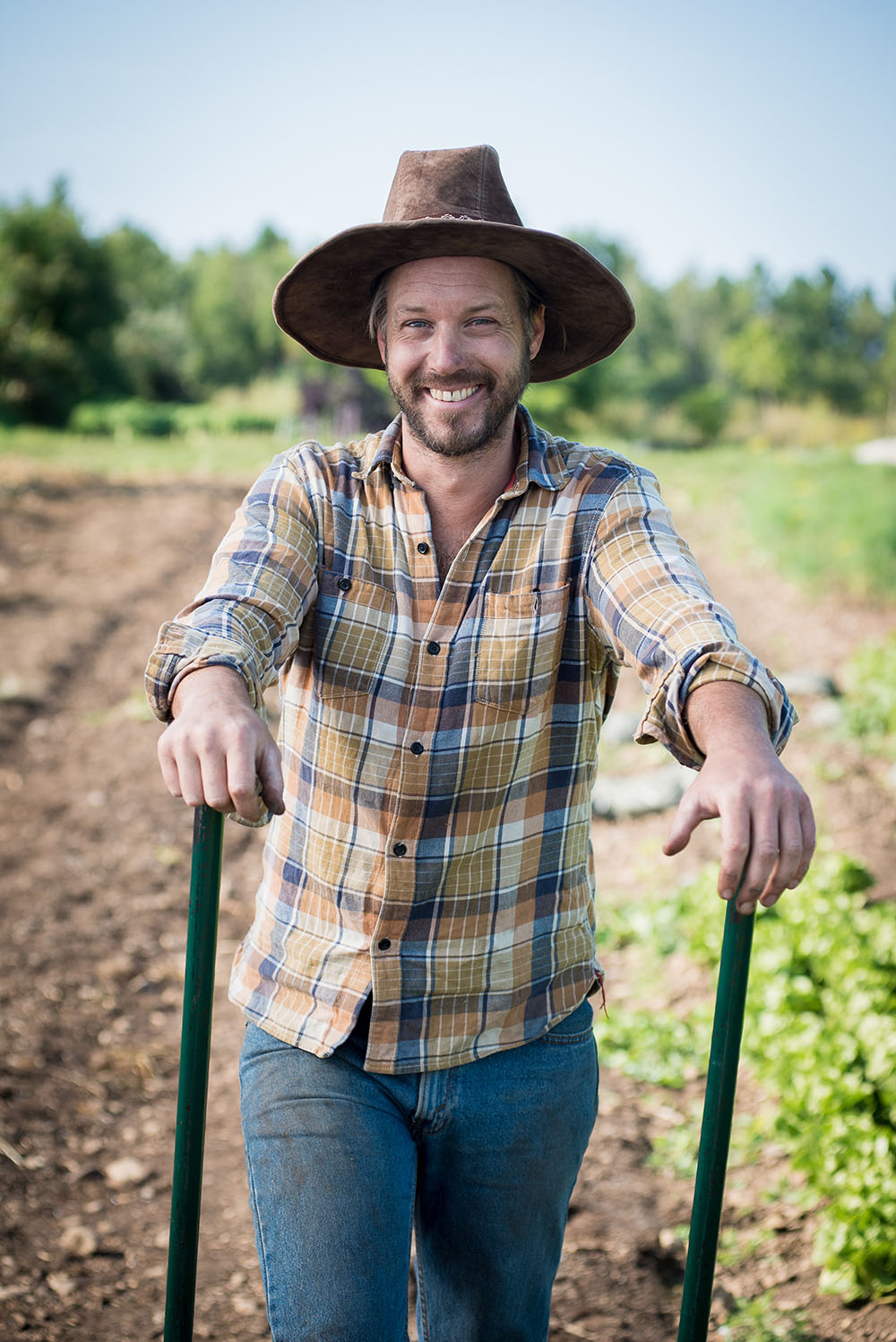

Jean-Martin Fortier is another Canadian doing exceptional things with small areas of land.

He also uses an intensive growing system in his market garden and generates revenues similar to Curtis.

Jean-Martin is currently engaged in a very interesting project called La Ferme des Quatre-Temps. This is a project attempting to demonstrate how farms of the future might operate by blending modern technology with models developed from nature.

Jean-Martin is known for his ability to produce industrial quantities of produce without the industrial equipment (and associated price tag).

Friday, January 2, 2015

Economics and Permaculture

Economics and Permaculture

Permaculture is as much about developing sustainable and non exploitative economies as it is about sustainable and non exploitative agricultural systems.

If permaculture is going to survive and thrive, it must also make economic sense from a business perspective.

There are two business models I am currently aware of that have been developed for the specific purpose of acting as a template that other people can utilise when going into industrial scale permaculture for profit.

The first model is the "Fiefdom" model developed by Joel Salatin. Joel is a multi-generational farmer who argues that young farmers can't get into the farming business unless old farmers are getting out. Meanwhile, old farmers can't get out unless young ones are getting in.

To address this conundrum, Joel recognised that young farmers want their own independent, yet connected, profitable enterprise (fiefdom) within a farming operation to which they are wholly responsible.

He maintains that a farm is not robust or sustainable unless it is generating at least 2 income streams, and the fiefdom model addresses this by creating many independent businesses within the overall farming operation.

A fiefdom is created when a business agreement in the form of a Memorandum of Understanding (MOU) is signed by the farmer and an independent business owner who wishes to operate within the farm. 

Provided that the business concept fits well within the network of other fiefdoms, and the farm as a whole, then a mutually beneficial agreement is reached and the new operation is introduced to the mini-economy.

On Polyface Farm, there are very few employees, as the people who work there operate their own business on the premises.

Here is a great article describing the fiefdoms on Polyface Farm and a link to Polyface Farm's guiding principles.


The second model is very new (as of April 2014) and is spear headed by Jack Spirko.

The initiative is called PermaEthos, which is a business that has created a template for establishing community based farming operations as profitable enterprises. 

There is a very good pod cast series available where Paul Wheaton (the Duke of Permaculture) interviews Jack on this new undertaking:
Part 1 and Part 2.


Their flagship proof of concept farm is called Elisha’s Spring Farm located in West Virginia and is currently in the early stages of establishment:


The main difference between these two models is that PermsEthos provides a template and a more traditional corporate structure to their organisation. For example, they have an advisory board, shareholders and a board of directors.

The fiefdom model is more of a conceptual design, and Polyface farm is a successful working implementation of this concept.

Whichever system you follow, be it your own, or one of the models described here, the role of debt in your enterprise will play a key part in determining your success.

Modern farmers are typically heavily indebted due to the huge capital outlays required for a modern operation. They indenture themselves, and their future generations to the bank, effectively enslaving themselves to the point of perpetual serfdom.

It doesn't have to be this way. There are alternatives. Social networks within your local community are as powerful as they ever were, and yet we seem to have discarded them and taken on the mantra of being "self made".

Why borrow half a million dollars from the bank to purchase a big fancy combine that you use half a dozen times a year when you could rent one from a neighbour? You pay for it as you need it, and you don't have the headaches of storage, maintenance, and insurance. 


Joel Salatin: Debt Free Farming


Wednesday, September 3, 2014

Why Own Land When You Can Control It

Why Own Land When You Can Control It?

People seem to be fixated on the idea of owning land. They always have, and probably always will.

For a young person looking to work on the land, loading up with hundreds of thousands of dollars in debt just to acquire land is often a daunting prospect.


Before they even get to the starting gate, they're debt slaves to the bank, and the possibility of ever achieving financial independence is somewhere off in the distant future.

Throw in a gazillion dollars of more debt for tractors, combines, other farm equipment, and of course stock, and it quickly becomes obvious why there are so few young people getting into farming. Quite frankly, you would have to be insane.

Meanwhile the existing population of farmers are getting older and less physically capable of maintaining a profitable enterprise on their farm. The chances are they're also in debt with very few options for retirement. Many farmers have actually died, and their widows are left with a farm to run, but no idea how they will cope.

As a result, many farms slowly run down and eventually revert to some semblance of it's natural state as the forest reclaims the pastures.

I was listening to a podcast recently by a man named Greg Judy. He was speaking about how he went broke as a farmer in the late 1990's, and with less than $10 to his name he lost his farm and had to start over with nothing.

Today, Greg operates 12 farms totalling over 1,500 acres on which he runs over 1,000 head of cattle along with sheep and pigs.

The key to his success was the realisation that he didn't need to own the land or the livestock to be a farmer. 

Greg leased some land from an absentee land owner for a ten year period, and then rented his services to livestock owners who paid him a monthly fee per cow.

Because he could not afford farm equipment, he simply did without it, and changed his farming methods accordingly through the application of high intensity mob stocking and movable electric fences.


Even today, he doesn't own a tractor, doesn't make hay, doesn't fertilise, or irrigate. And yet the land he controls gets more fertile and productive every year.

Luckily for us, Greg wrote a book about how he achieves this, and you can purchase a copy from his web site and you can watch a handy book review below.


Granted, Missouri is a far cry from Thunder Bay. For example, he gets snow, but not for 6 months of the year.

However, I believe that many of the principles of his practice still apply. Lease instead of own, rent instead of buy, and stay out of debt as much as possible.

I'll finish with this... After Greg had been farming his leased farm for a year, the land owner turned up to see how things were going. When the tour was over, the owner took out the lease and tore it up in front of Greg, told him that they are going to forget about the arrangement they had, and drew up a new lifetime lease for him.

People who own land typically love the land, and have an emotional connection to it. 

Imagine the effect when they see someone being a good steward, and who demonstrates through their actions that they value the land in a similar way.